
Leon
Milk pH
Hi, Milkfans
The pH of milk should ideally be between 6.60 and 6.75.
When milk pH goes into the 6.5’s it is considered to be turning sour and above 6.80 there is reason to suspect mastitis(udder infection) or alkaline soaps – usually because of insufficient rinsing of tanks after cleaning.
Regards,
Leon the Milkman

How to use Pearson’s Square
Hi, Milk Scientists
Need to know how much milk to mix with another to get a certain butterfat %?
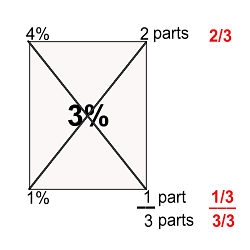
Use the Pearson Square or the “milk butterfat square”. Subtract diagonally and convert to the positive if not. Mix the parts as calculated and you will get the center value ( the one you wanted ).
In this example 2/3 of the final volume of the 4% milk must be added to 1/3 of the 1% milk to get 3% milk. So if you wanted 1000 L of 3% milk, then you would need 666 L of 4% milk and add that to 333 L of 1% milk.
This also works well for juices with different concentrations (Brix).
Kind regards,
Leon the Milkman

Remaining milk – calculation
Hi, Dairy Scientists
You start off with 3.8% butterfat and you skim off to 2% – what is the volume of milk remaining?
Let us say you started off with 1000 liters of milk and your resulting cream has a butterfat of 40%
3.8% – 2% = 1.8% difference per part
1.8% x 1000 liters = 1800 parts of fat to be removed
1800 ÷ 40% = 45 liters of cream
1000 liters – 45 liters = 955 liters of milk remaining.
Don’t ask me why or how – this is the way to do it – agreed?
Semi-convinced,
Leon the Milkman
Buffalo milk for China
Hi, Guys
It seems that as much as Japan do not want to drink their milk, China does.
They want cheese and they have their eyes set on Buffalo milk to be the supply – read more:
http://news.xinhuanet.com/english/2006-04/22/content_4459931.htm
Also check this link out if you want more on China: A world of possibilities for agri-business in China. : An article from: State News
Kind regards,
Leon the Milkman
Cow Abduction
Hi, Cow Lovers
I’ve seen some weird stuff, but this takes the cow:
If only it wasn’t true.Â
Regards,
Leon the Milkman

Wired Cow
Hi, Cow People
Here is some South African Cow Wire Art I bought on the side of the road. Yes, we have everything right here in Africa. 🙂
Kind Regards,
Leon the Milkman

Goat Milk Composition
Hi,
Milk composition differ hugely from one individual animal and one species to the next. However I have found goat milk in our region to have lower solids than cow milk.
Usually in the range of 3.5% Fat, 3% Protein and 4.5% Lactose.
I think some of the beneficial differences between cow milk and goat milk can be attributed to different proteins and fatty acids in the goat milk.
Like the medium chain triglycerides in goat milk that do not follow the same metabolic pathways as other fats in the diet, but are absorbed more easily.
Till later,
Leon the MilkmanÂ

Gouda – Sweetmilk Cheese?
Hi, Cheese Fans
Gouda cheese is a sweetmilk cheese. What does that mean?
Well, during the cheese making process some of the whey is removed and substituted with water. This removes lactose and thus in effect some of the acid forming capacity of the whey, because the lactose is converted to acid by the bacteria that you add.
Therefore you end up with “sweeter milk” and therefore sweeter cheese.
Sweet isn’t it!
Leon the Milkman
Â

NOT Big in Japan?
Hi, Milkfans
If you love milk, your jaw will hit the floor when you read about this situation in Japan.
Click the link below:
http://www.yomiuri.co.jp/dy/business/20060418TDY03005.htm
Bye for now,
Leon the Milkman
P.S. This following link goes more indepth for professionals: Japan Milk Report 2002
Quick Casein Test
Hi, Cheese People
If you have a automated milk composition analyzer it would be possible to get a quick indication of casein by putting the milk through and then setting it with rennet. Take some of the whey and put it through the analyzer as well. Since the rennet binds the casein, by doing a subtraction of the whey protein from the whole milk, you should get the casein value.
Of course some of the more modern analyzers can do the casein automatically, anyway, but this method should help the other guys out there.
Regards,
Leon the Milkman

 Follow me on