Daily Archives: April 25, 2006
How to use Pearson’s Square
Hi, Milk Scientists
Need to know how much milk to mix with another to get a certain butterfat %?
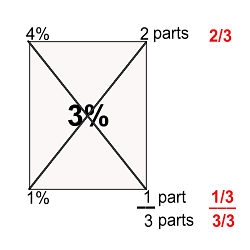
Use the Pearson Square or the “milk butterfat square”. Subtract diagonally and convert to the positive if not. Mix the parts as calculated and you will get the center value ( the one you wanted ).
In this example 2/3 of the final volume of the 4% milk must be added to 1/3 of the 1% milk to get 3% milk. So if you wanted 1000 L of 3% milk, then you would need 666 L of 4% milk and add that to 333 L of 1% milk.
This also works well for juices with different concentrations (Brix).
Kind regards,
Leon the Milkman


 Follow me on